Sir John Norquay
|
|
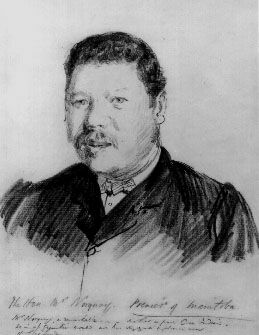
John Norquay was a Metis, half Indian and half English Canadian, who became premier of Manitoba in 1878. He was orphaned as a young boy, but was taught and treated well by those who cared for him. He spoke six languages, and this ability helped him to provide the leadership that the multilingual Red River Settlement of Manitoba needed in those days. Louis Riel was spokesman for the Metis, but Norquay was the leader of the Indian/English people. It was Norquay's ability to support Riel's aims, while opposing his tactics, that helped in winning provincial status for Manitoba. As a teacher, farmer, politician, and premier of Manitoba, Norquay was always intensely loyal to his people and a man of high personal integrity. |
|
from The Western Home Monthly May, 1930 Memories of John NorquayBy R. G. MacBeth, D.D.One day a few years ago I was delighted to come across, in Vancouver South, the familiar name of John Norquay, the native son of Manitoba who became premier of the province in which he was born. His name was on one of the splendid new schools of the locality and had evidently been placed as a designation on the school building by some who knew the fame as well as the name of the giant premier whose eloquence and ability made him a most conspicuous figure in the Middle West and farther East. It was in that same goodly province of Manitoba that I first saw the light of day and I knew all my life. I was aware that his standing in his native province was high and splendid but it was gratifying to a fellow-citizen in the first of the Western provinces to enter Confederation to know that his fame had reached out to the Pacific, so that an important public institution was named in his honor. For it must be remembered that Norquay died at a comparatively early age, nearly forty years ago, when this province by the western sea was still, in a sense, remote from the East in its social and public life. Hence it is a pleasant thing to know that the greatness of his natural gifts his integrity of character, his interest in education and his services to Canada are recognized so far afield as the Pacific shore. Winnipeg, of course that knew him at first-hand, long ago named a school, not far from his residence, after this distinguished citizen. |
|
|
It was while Mr. and Mrs. Norquay were living there on the farm at Park's Creek that I got to know him more particularly in a personal way. Their six sturdy children came to the public school where I was then teaching. Some of them were at least of equal stature with their young teacher. But they were well trained by their big father, who was to them a sort of older playmate and companion, and by their quiet mother, whose very gentleness placed a wholesome restraint upon their robust and exuberant spirits. One Saturday afternoon when I called to see Mr. Norquay, his wife had to call him in from the wheat harvest, where he was using his giant strength in the fine art of pitching sheaves on the wagon racks for stacking in the yard. He came in at once, coatless and warm with his exertions, but in a most cordial mood, so as not to embarrass the young teacher who had been rather timid about calling on the great man. 1 recall the interview with much delight. Norquay took great interest in the school and made a practice of coming down from Winnipeg for any special occasion. It was a joy to him to get home, and I recall how his children used to climb and clamber all over him as he sat in his favorite chair, lie would take part joyously in our little school concerts, and his presence always drew a crowd, as he was immensely popular with the people who knew him best. He had a strong, clear, resonant voice and could sing the immortal "Annie Laurie" so as to bring down the house. When encored, he would repeat a verse and there was a legend the he never cared to singe any other song. But he sang it well. One evening, before a concert, I called at the house and asked him to give us an address or a reading. He said he would be delighted if he could get anything to read and asked the boys to hunt up something. They selected a piece about a lodge initiation which was so full of humorous situations that it set the big Premier laughing with delight. And when he started to read it at the concert, the humour of it broke upon him afresh till he laughed so heartily himself that the audience rocked in an uproar of hilarity. Nothing gave Norquay more pleasure than to contribute in any way to the enjoyment of the people who came in crowds to hear him. When Norquay spoke on important occasions in public life he had the impressiveness of the physique and voice which give advantage. Standing six feet three and built in massive proportion, he was a commanding figure. As an indication of his strength, I recall a rather riotous meeting: when two men who led opposing factions were seemingly determined to attack each other. Norquay, leaving the platform, forced his way through the crowd till he got between the two combatants, who were suddenly separated as decidedly as if a rock had dropped between them. Norquay laughingly told them to be good boys and sit down, which they did lest this kindly giant might knock their heads together. Norquay's education had not been extensive, but he had read widely in the classics, both ancient and modern, and had an unusual command of language in public address. He was rather fond of latin quotations and could use scriptural allusions with effect. He had a voice of bell-like clearness and power. Perhaps it may have been through his maternal ancestors that there came to him the gift of that remarkable eloquence which had so wonderful a place by the campfires of the Great Plains. I heard him speak on many subjects, on various occasions, and always with tremendous effect. Once, in my law-student days, I recall that the St. George's Snowshoe Club went to St. Paul, Minnesota, to help the citizens there with an ice-palace and winter celebration. It fell to the Winnipeg contingent to put on a miscellaneous concert before an audience that ran into thousands from all over the States. It was a big undertaking, but Norquay happened along on the way back from Ottawa and with his usual desire to help the boys, agreed to appear and give an address at the concert. The massive figure of Manitoba's Premier, clad in full evening dress, caught the imagination of the great audience at once. The clear ringing quality of his voice reached to the farthest corner of the vast hall, while the rolling periods of his eloquence as he spoke of international friendship evoked thunderous applause. He made our concert a real event in the celebration. Once, in the Legislature at Winnipeg, I recall him when he was in opposition leading a small following as the result of complications arising between the local and Dominion authorities. He was defending his record so well that a member of the other side, angered by his success, taunted him with his mixed blood. Norquay drew himself up to his colossal height and threw up his right hand with dramatic power. Then, pointing to his wrist, he said he was not ashamed of the strain that darkened his skin, but there was no blot upon his record! And he would leave an unsullied name to his children and to his country. The words were uttered with such tremendous passion and sincerity that cheers broke out from both sides of the House, and that speech remains as the loftiest example of eloquence that the Legislature has known. His attachment to his native province was profound. He has special claim to being gratefully remembered for securing from the Dominion a grant of a hundred and fifty thousand acres of land as an endowment for the struggling infant University of Manitoba. To some it did not seem I of great value at the time, because the country was new and sparsely settled. But that land eventually did much to put the University on its feet. Norquay had a keen sense of gratitude, and was quick to acknowledge the slightest effort to serve him. Once at a political meeting in Kildonan he was being hotly attacked by a brilliant lawyer from Winnipeg because he had allowed some of the members of the Government to plunge the province into some unnecessary expenditures. There was some ground, doubtless, for the attack, as Norquay was a little too trustful of others for this work-a-day world. A small boy in the audience saw that Norquay, whom he greatly admired, was feeling the attack and this boy, though not understanding the whole discussion, watched for an opportunity to come to the assistance of his big hero. It came when the Winnipeg lawyer, summing up the opposition programme, declared vehemently. "This is our platform, gentlemen. We are going to stand on that platform and we are going to carry that platform in this country." At that point the small boy saw the incongruity in the expression and shouted: "How are you going to carry the platform if you stand on it?" A meeting, as everyone knows, gets to a tense point where a relief is welcomed, and that schoolhouse rocked with laughter till the effect of the lawyer's speech was forgotten. It was a proud moment for that small boy when Norquay looked him up at a neighbor's house after the meeting and, shaking hands, thanked him for his timely intervention. Next day the small boy met the lawyer in Winnipeg, but the lawyer was a good sport and he said with a laugh: "You knocked my speech out last night, but it was a fair blow," at which the boy was a good deal relieved. Norquay was twenty years in the Legislature and over fourteen years in government office, but he had never dreamed of making money, and died poor. Norquay was a fine example of a man who was anxious to do something for his country, regardless of whether his country did any thing for him or not, which characteristic proved him a real statesman. Note: this article from the Winnipeg journal, The Western Home Monthly was found in the Norquay Log book that contains information about the school from 1913 to 1975. Here is a scan of the original article. |
|

