|
|
|
|
|
|
Norquay School in the 1940's |
|
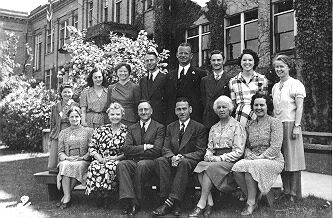
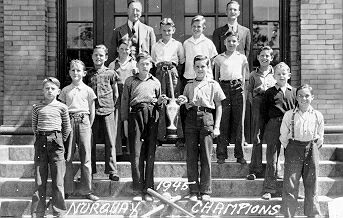
In the 1940's Norquay School had grades 1 to 8. About 1946 or 1947 the Vancouver School Board set up kindergartens in a few schools as a pilot project and Norquay School was one of those schools because it was deemed that the students there were disadvantaged. Gladstone Secondary School and Windermere Secondary School had not yet been built and so after grade 8 the students went to various secondary schools - John Oliver, Vancouver Tech, Britannia, King Edward and Grandview High School of Commerce. The latter two schools no longer exist. |
|
The School Day |
|
The subjects we studied were much the same as they are today although the material covered in each subject in some cases was very different. There was more emphasis on History and Geography in Social Studies and, of course, Science was very different given the increase in scientific knowledge in the past sixty years. There was a great emphasis on handwriting and we learned the McLean Method of writing. We had writing (and printing) instruction books and we spent a lot of time doing writing exercises to perfect our writing skills. We printed or wrote in pencil until about grade 4 or 5 when we began to write in ink. We used long straight pens with metal nibs that we dipped in liquid ink. There was an inkwell at the top of each desk which had to be filled with ink. A student was chosen by the teacher to be the ink monitor and that person filled the inkwells using a large can with a long pouring spout. Music class was singing and learning to read music. There was no learning to play musical instruments like recorders or guitars. In the primary grades the children did play rhythm instruments. There were choirs of the best singers which were chosen by the music teacher and which competed in music festivals. In grades 7 and 8, the girls studied Home Economics and the boys were taught Manual Arts. For these subjects the students traveled to Carleton School at the corner of Joyce Road and Kingsway one afternoon a week. They usually walked there but sometimes rode their bicycles or took the streetcar. In Manual Arts the boys did some simple woodworking and learned basic electrical skills. The girls learned to cook simple dishes like porridge, muffins and puddings in Home Economics for half the year and in the other half of the year they learned to sew. In grade 7 they made an apron to wear in cooking class and in grade 8 they made a dress. |
|
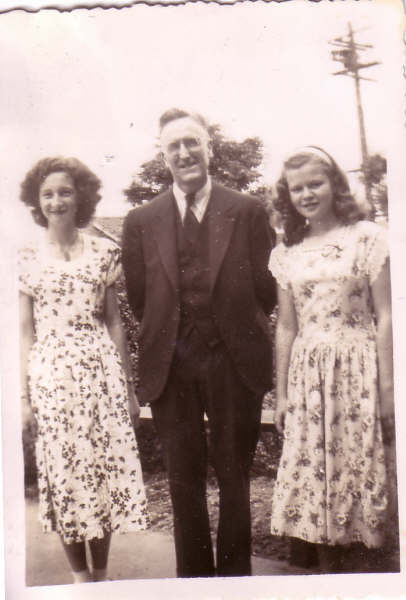
This is a picture taken in June,1948 of Dawn Cartwright and Betty-Anne Hillman with the principal, Mr. Clarke. |
|
Classroom Discipline |
|
Classroom discipline was very strict with a firm policy of no talking in the classroom. There was no co-operative learning - marks were very important and the children were ranked and the rank of each student in the class was posted. The feelings of the children were rarely taken into account. One of my fellow students wrote - "Every day we had to stand at the front of the class (in grade 4) and take turns reading aloud and you were graded on your reading performance. For me this was very frightening as I was very nervous. I can remember standing outside in the playground area on the verge of tears wanting to run away but I had no place to go. I looked back at the school and thought 'what am I going to do?' I have eight more years of this." If a child misbehaved badly or deliberately broke school rules then he was sent to the principal's office and was strapped by the principal. The strap was a wide leather belt and was administered to the palms of the hands. The number of times depended on the severity of the offense. Many of the teachers took discipline into their own hands. One student says, "Miss X broke a yardstick over Roy Logan's head and Mr. X could throw an accurate piece of chalk or a blackboard eraser if he caught someone talking." |
|
The School |
|
The school itself consisted of the brick building without the alterations that have been done to it. The students sat in desks in rows in the classrooms and the library was an ordinary classroom with desks. We had at least one library period each week and it was used for reading. Most of the learning was done from textbooks; research projects were not part of the learning experience. The staff room was on the floor a the top of the main stairs and was much smaller. There were no classrooms in the basement and the basement was used as a play area if the weather was bad. It was strictly segregated into the boys' side and the girls' side. |
|
Health |
|
In the 1940's there was no public health care system and medical attention was very expensive. There was a school nurse who was at the school most of the time. There was a school doctor who visited the school on a regular basis to check on the health of the students. A school dentist visited the school and examined the teeth of the students. There was a school dental clinic at Florence Nightingale School where children could go to have their teeth fixed for little or no cost. In those days goiter was a serious health problem. It was caused by a lack of iodine in the diet. To prevent this we were given iodine tablets once a week at school. They were chewable tablets tasting somewhat of chocolate. Once table salt had iodine added to it as it does today we didn't take the tablets any more. |
|
Recess |
|
At recess and noon the children played outside on most days. Depending on the season the activities varied. Groups of boys played soccer, girls skipped or played ball bouncing games (usually with lacrosse balls) and both played marbles. We could bring money and order white milk or Vico (which is what chocolate milk was called) to drink at recess. The end of recess was signaled by the ringing of a hand-held bell. "Very few kids had a watch. I was fortunate because my grandfather was a jeweler and he bought me one. So I was picked to ring the large cowbell for recess and lunch hour," wrote one student. There were also interschool sports played after school and teams of girls and teams of boys played volleyball, soccer, and softball against other schools in the area. |
|
Sports Day |
|
Sports Day was a major event in the school year. The festivities began at the front of the school. Various patriotic songs were sung (this was wartime) and there were performances by choirs and students dancing around Maypoles. One of my classmates wrote, " I remember the time I was chosen to sing "Land of Hope and Glory" at the May 24th holiday programme (sports day). I stood at the open window at a microphone and was sure everyone could hear my knees knocking!" There was a parade of decorated bicycles and a prize given for the best one. Later there were track and field activities - footraces, relay races, high jump, long jump, etc. - with ribbons awarded to the first three finishers in each event. The school was divided into four houses and points were awarded to each house as its members won ribbons. The competition was serious with the emphasis on winning not just having fun. |
|
Going to School During World War II |
|
For most of our years at Norquay School Canada was at war. All of the students had someone they knew - father, brother, cousin, neighbour, - overseas fighting in Europe or Africa or Asia. In the school, the war effort took several forms. We were encouraged to buy wartime savings stamps which I think were 25 cents and when we had accumulated enough we could exchange them for war bonds. These were guaranteed by the government and were redeemable (with interest) after the war. This was one way the government could raise money to pay for fighting the war. One of the students wrote, "We had a Junior Red Cross Club and we made bandages with white flannelette". Our families were encouraged to grow Victory gardens which were vegetable gardens so we could raise some of our own food. At school we had air raid drills. Sirens blew and as one student wrote "I remember crouching down in the last aisle (of desks) in case the windows got broken by a bomb blast". One of the sad things that happened was that there was a Japanese-Canadian family who lived on Horley Street and whose children went to our school. One of the girls was in our class and one day she was no longer there. She and her family had been interned and eventually sent away from Vancouver. |
|
After Norquay |
|
By the time we left Norquay in 1948 the war was over and the post war boom was on. We went our separate ways to high school. Some dropped out after grade ten (jobs were easy to find in those days), most graduated from high school and found good jobs in offices, in the utilities companies, or the building trades, some graduated from university and became doctors, engineers, nurses, or teachers. Most of us were able to live useful and successful lives. We look back on our years at Norquay with mixed feelings but we learned things and made friends that have stayed with us through out our lives. Many of us who went to Norquay School together 60 years ago are still in touch with one another. This was written by Sally (Robertson) Hughes, Cleo (Bielfedlt) Drew, Dawn (Cartwright) Krugel, and Mildred (Todhunter) Thiessen. (Mrs. Hughes also taught at Norquay School in the late 1980's and early 1990's.) |
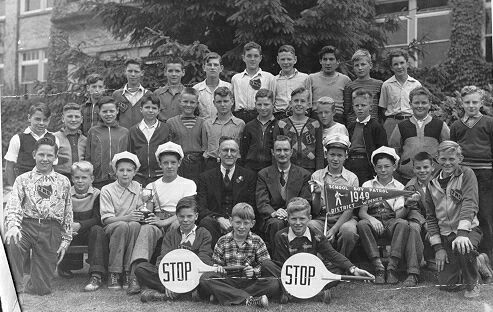
1949